| Join | Official Historian | City of Stamford | Blog | About Us | |
| Jewish Historical Society | Civil War Roundtable | Contact Us | |
 |
|
|
Lectures and Presentations
Layer by Layer How Women Dressed in the 1860spresented
November 2, 2003 at the annual Victorian Tea
|
||||||||||||||||||||||||||||||||||
 |
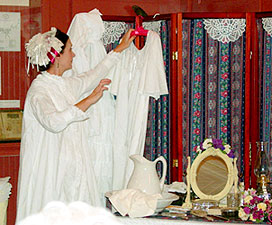 |
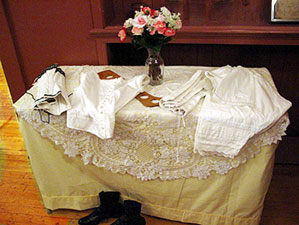
| Samples of actual antique underpinnings that every woman would have worn. | |
 |
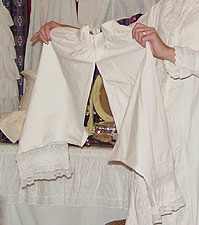 |
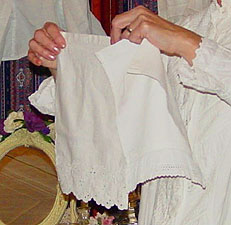
| Antique pantaloon extenders and split pantaloons. | |
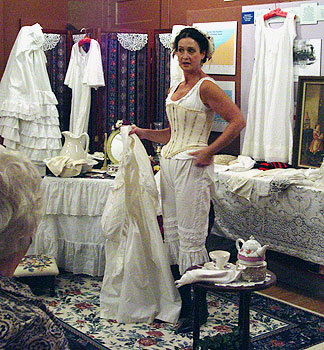
The corset
 |
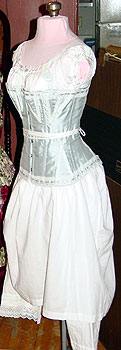 |
| 1860s style of corseting above left, and a close up of early 1900s style above right. | |
 |
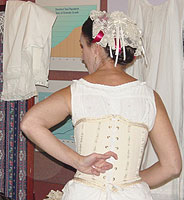 |
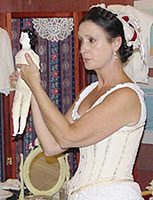
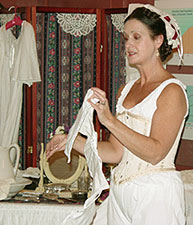
| Jane demonstrating the desired figure shape as shown on an 1860s period doll while wearing an 1860s style corset. | The back lacings of a corset would allow for a little space in between each side so the individual backbones would fit comfortably. |
 |
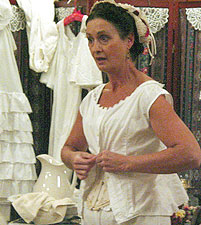 |
| This is a sample of a child's corset which girls as young as 7 years of age would have begun to wear in order to misshape their ribs. | A corset cover is worn on top of the actual corset to protect it from becoming soiled during its regular daily wear. |
Waist and skirts
 |
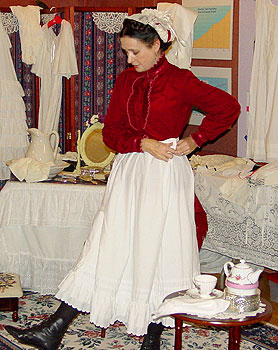 |
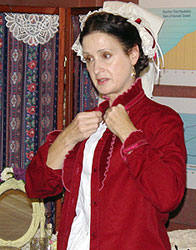
| Jane demonstrating a full blouse known as a waist back in the 1860s. | An under petticoat reached just down to the boot tops and covered the pantaloons. |
 |
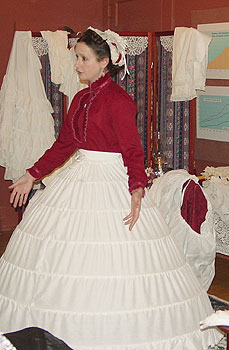 |
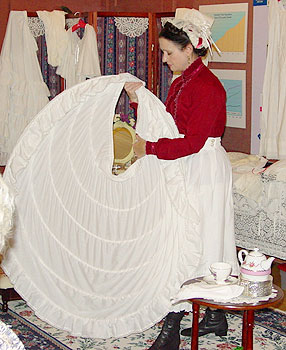
| A series of hoops encased in a slip known as a crinoline supported the weight and fullness of a skirt. | |
 |
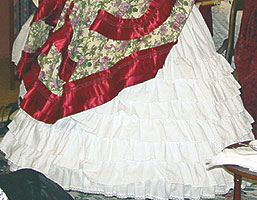 |
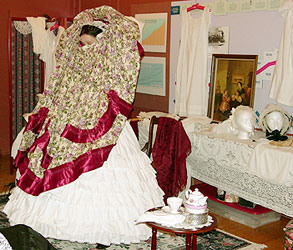
| A full skirt fits on top of the ruffled overpetticoat which covers the hooped crinoline. | |

 Dressing
up
Dressing
up
Jane Sabatelli
Civil War Exhibit 2003
Photos © Nancy Louth