| Join | Official Historian | City of Stamford | Blog | About Us | |
| Jewish Historical Society | Civil War Roundtable | Contact Us | |
 |
|
|
Photo Archivist's Selection of the Month: March 2003The Portable Typewriter and its Uses, 1913
The Guide to Nature magazine issue of August 1913 brings us another lively article about businesses in its "Local Department of Observations and Suggestions" section. Manufacturing plant photos from the article may be found here. The Blickensderfer Typewriter Company is the subject of other pages on our website as well. A Typewriter Out of Doors as well as for Office.
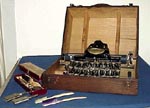
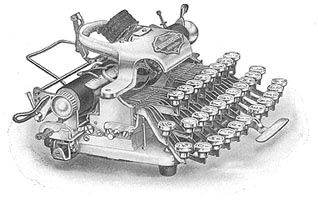
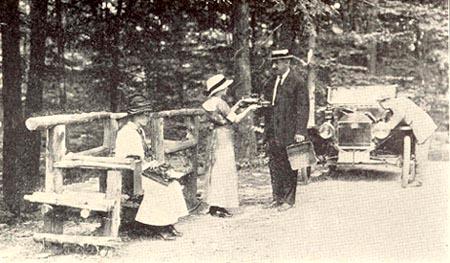
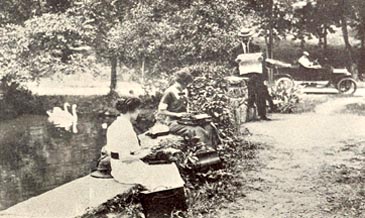
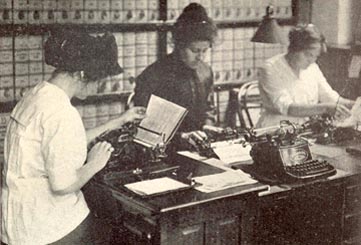
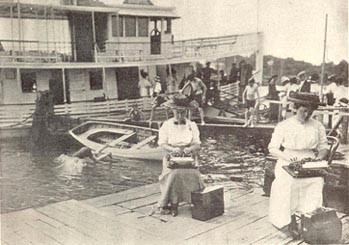
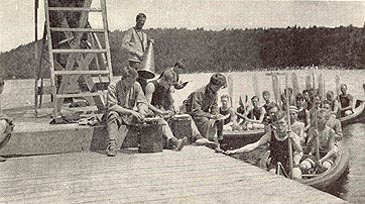
Any first-class typewriter is good to use out of doors if you have a porter or expressman to carry it for you. But there is a typewriter made by The Blickensderfer Manufacturing Company of Stamford, Connecticut, that is not only first-class but is easily portable. It weighs only five pounds and has been designed to meet all requirements in travelling. This little gem of a thoroughly efficient typewriter is therefore entitled to be enrolled as an assistant in nearness to nature. Authors, professional people, naturalists, and all other people who love to write out of doors, or to utilize some of the time in travelling, will find in the Blickensderfer a really enjoyable and helpful companion. Nature advances from the simple to the complex. The evolutionist tells us that he can show continuous progress from a simple bit of jelly such as the amoeba, up to the highest and most intricately complex form of animal life. But man in many cases develops his machines by the reverse process. Early forms of the typewriter possess features that later observation found not to be practical. It is an interesting fact that the inventor of the typewriter had in mind a machine as elaborate as a piano, and patterned his construction on that form. One might suppose that, he would think of the simplest possible method of writing, say by a lead pencil, and work up from that point of view. But he did not. Instead of that he selected a piano as his pattern and worked toward the incomplex. It has taken man several decades to learn that typewriting can be done with a machine so simple that it occupies little space and is as easy to operate as a lead pencil, easier in some situations.
The inventor of other forms of typewriters seems to have had the astonishing belief that in order to impress a letter on paper, the operator must have a training as thorough as that of the pianist. We laugh at his idea that typewriting must be so elaborate a performance, yet some of us have not learned how incomplicated a matter typewriting may be, and how simple and light an effective machine may be. The trend of modern typewriter construction has been from the complex to the simple, but only one manufacturer seems to have swept aside all those early traditions and beliefs in elaborate and complex construction, and gone to the simple by the shortest and most direct road. We express our thoughts with the use of twenty-six letters, and all ordinary mathematical computation by ten symbols. To carry these letters and figures, there is no need of a big and cumbersome typewriter, when a simple little machine that you can hold almost in the hollow of your hand will do the work and do it well. If nature had started to build a machine, she would, if we may judge from the manner in which she acts with plants and animals, doubtless have begun with a simple form like that made by The Blickensderfer Manufacturing Company, and have left 'it as being complete and satisfactory. It surely is the natural form of simple and successful typewriter, for, in being simplified, it has lost none of its efficiency. Its simplicity has rather added to its effectiveness.
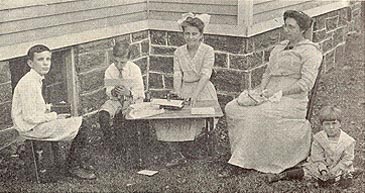
All this is done away with in the Blickensderfer. It is not a milliped with a thousand legs to care for, but all its letters and figures are on one simple little cylinder, not much larger than a thimble, so small indeed that you could easily carry it in your vest pocket. If you wish to change the entire alphabet, turn a screw, slip this cylinder from the spindle, slip on another, and presto, you have changed every symbol, whereas with the old, elaborately constructed machines it takes two days and much expense before the repairs can be made. How slowly the world learns nature's method of doing things simply and yet effectively ! If you want to take one of those intricate Brobdignagian typewriters to the woods, to your camp, or on a boat, what must be the process? If you are busy, or not inclined to attempt the labor of packing the machine, you would call in a carpenter and have him get a cumbersome box and pack this elephantine affair into it, giving him proper cautions about having it firmly screwed into the box with plenty of packing around it. Next you would telephone for an expressman to come with a wagon and take it to the depot whence it would be shipped to the express office nearest to your destination. I f this were in some encampment, you would, at the end of the route, hire another expressman to haul it over the hills to the camp, to be followed by a repetition of the packing process. But with the Blickensderfer there is none of this. You open your morning's mail and find that your friend in camp says, "Come up and spend a few days with me and come at once." Fortunately you have a Blickensderfer typewriter in the office and you do not need to suspend your work. You lift one of these little instruments as easily as you would lift a pair of field glasses. You tuck it into a corner of your dress suit case. You hardly know that you have the machine with you. When you arrive at the camp you do not need to set up a special office. You hold the little typewriter in your lap and proceed with your correspondence. With this pretty little thing you can in addition utilize the time of traveling. If you take out a pad and a pencil on the railroad train, and try to write a letter, your correspondent will be likely to say, "What is the matter with that fellow? Why doesn't he write the English language instead of making these crow tracks ?" But with the Blickensderfer everything is as calm and as serene as the proverbial May morning and everybody is happy. The jarring of the train does not irritate your nerves as it does when you try to hold the pencil, nor those of your friends when they try to read what you have tried to write. Your vacation is a real vacation if you have a Blickensderfer because it prevents and relieves nerve strain. You do not feel that your typewriting work must be suspended, nor that you are an annoyance to your friends in their frantic efforts to decipher your pencil marks. The little Blickensderfer comes to your aid, all is clear and plain, and both writer and reader are contented. Perhaps you feel the need of a typewriter but have none. You plan to buy one. You look through various catalogues and throw them aside with the conviction that you cannot possibly afford to pay one hundred dollars for such a luxury. Then you pick up a Blickensderfer catalogue. It shows you that an effective, simple, compact, well-built machine may be obtained for only $50.00 dollars. The simple things of life are the most satisfactory and a typewriter is no exception. You write with it, you enjoy it, and let your little girl take it under the trees, where she writes her childish note's, and incidentally learns how to put together letters and words, and that there really is a difference between a comma and a period. The simple life is to be lauded even when applied to typewriters, and when you have read this plain and simple statement about this plain and simple machine, you will be treating yourself kindly if you send for one of them. Then, like the hero and heroine of the modern novel, you will live happy ever afterward.
Blickensderfer Typewriters Prior Photo Archivist Selections of the Month |
|||||||||||||||||
|
|