| Join | Official Historian | City of Stamford | Blog | About Us | |
| Jewish Historical Society | Civil War Roundtable | Contact Us | |
 |
|
|
The Stamford Historical Society PresentsGRACIOUS LIVING IN STAMFORD
|
|||||||||||||||||||||
1 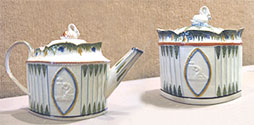 |
2 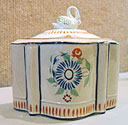 |
||
| 1. Teapot and Sugar Bowl. Pearlware with molded body painted in underglaze green and ochre in Pratt-type decoration. Staffordshire, c. 1790-1800. 6 1/2" high. 2. Sugar Bowl. Pearlware, silver-shaped body with underglaze painting in cobalt, blue, green and ochre, banded in brown. 6 1/4" high. |
|||
3 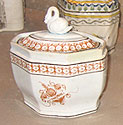 |
4 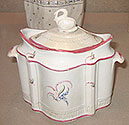 |
5 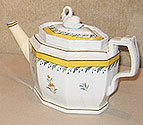 |
6 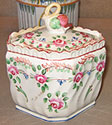 |
| 3. Sugar Bowl. Pearlware, octagonal shaped with sepia overglaze enamel painting and underglaze brown banding. Staffordshire or Yorkshire, c. 1790-1800. 6 1/4" high. 4. Sugar Bowl. Pearlware with silver-shaped body painted with sprig enamels overglaze in rose, pink, purple and green. Staffordshire or Yorkshire, c. 1790-1800. 5-7/8" high. 5. Teapot. Pearlware with octogonal silver-shaped body enamelled in yellow, green, cobalt blue and ochre. Staffordshire or Yorkshire, c. 1800. 6 1/4" high. 6. Sugar Bowl. Pearlware with swirl-molded body with acanthus leaf gallery, with overglaze painting in pink, green, blue and iron red. Staffordshire, possibly Harley (Lane End). 1800-1810. 6 1/4" high. |
|||
| Texts by Diana Edwards Roussel from the above catalogue. | |||
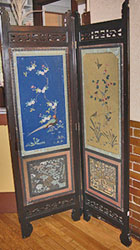
Chinese-style Screen, American, c. 1885
Machine cut three part screen frame has Chinese-style carved panels at top and bottom.
Polychrome canvas panels portray flora and fauna in Oriental style, and serve as an example of the late-19th century Aesthetic movement in America.
C955-415
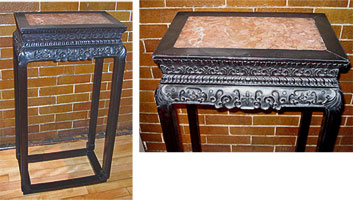
Chinese Urn Stand, Chinese, 19th century
Rectangular inset red marble top above a gadrooned and foliate-carved skirt, on molded legs joined by a box stretcher.
C955F-327
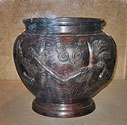 Bronze Jardinière
Engraved and repoussé design on exterior of birds in flight, with a huge hawk on a tree limb. Probably Oriental.
C955-551