The Stamford Historical Society, April 17, 2005 – March 31, 2006Portrait of a Family: Stamford through the Legacy of the Davenports |
|||
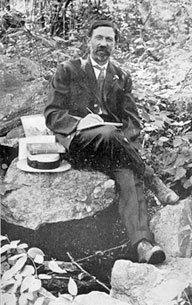
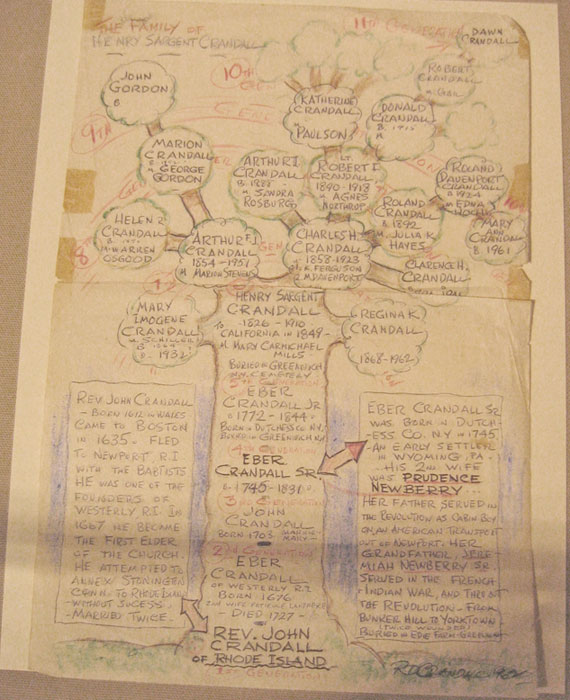
Charles Henry Crandall 1858–1923Charles H. Crandall, journalist, farmer, real estate agent and above all, poet, was born on a farm in the lovely hills of Greenwich, New York near Saratoga. He acquired most of his schooling here, on the farm and in the village’s typical one-room schools. When about 17 years old he went to work in the mercantile trades in New York, and after five years, to the staff of the New York Tribune in 1880. During the five years he spent at the Tribune, his “university years,” his poems began to appear with regularity in the most distinguished magazines and newspapers in America. In 1883 Crandall published “The Season,” an annual record of society in the New York area. In 1884 he married Kate Virginia Ferguson, a fellow journalist. After leaving the Tribune Crandall worked for a while with the New York Globe. But those were trying years. He felt himself in poor health, and within a relatively short time, he had turned down an important editorial position, suffered a nervous breakdown, retired from New York to move to a farm in Stamford, and suffered the loss of his wife Kate. But his desire to write remained strong. Crandall’s first scholarly work was published 1890, the anthology “Representative Sonnets by American Poets.” In the next twenty-eight years Mr. Crandall published six or seven volumes of his own poetry, mostly collected from magazines and newspapers in which his poems had appeared earlier. Crandall became a serious farmer, settling happily on beautiful hilltop acreage he named “Sky Meadows” in North Stamford. Crandall sold fruit, vegetables, eggs, chickens, firewood, hay and straw from his farm. Definitely not a “gentleman farmer,” he could handle a plow, hoe or axe along with the best, and selected his breeding stock with care. He became a council member of the Stamford Rural Association. In November 1891 Charles took his second wife, Mary Vere Davenport of Davenport Ridge, Stamford (1864-1939). In about 1898, Crandall became active in real estate, not only to work as an agent specializing in rural properties, but also to add to his own assets. He began to accumulate farms principally along North Stamford Road, now High Ridge Road. In 1907 he sold Sky Meadows and moved to a large farm called “Idylland” in High Ridge at Mayapple Road. He now offered a small horse pasturing service to New Yorkers, offering to meet horses arriving on the daily steamboat, “Shady Side.” By 1910, Crandall owned 270 acres with four or more houses and barns on North Stamford and Mayapple roads alone. At this point he began to sell these holdings, finishing in 1914 whereupon he moved to a house on four acres on Cedar Heights Road. Though divorced from Mary in 1916, he remained here to his death. Crandall was a member of the American Institute of Arts, Science and Letters. He also was a member of the Stamford Historical Society. In 1914 he told the editor of Guide to Nature that “Lincoln,” read before the historical society, was the best poem he ever wrote. |
John Davenport | John Davenport | John Davenport | John Davenport | John Davenport | John Davenport | William Davenport | Amzi Benedict Davenport | Mary Vere Davenport married Charles Henry Crandall | ||
| Charles Crandall’s earlier poetry featured popular rural themes: the glories of nature and man’s part in it. With the advent of the Spanish-American and World War I his focus changed to patriotism. As described in the Dictionary of American Biography, “That theme stirred him most – the thrill of seeing one’s flag unfurled, the superior bravery of the American military, the divine mission of America as guardian of her neighbors to the south, and as model for the governments of Europe.” The four sons of Crandall served in the World War, and though one was killed, Crandall remained a “boundless” patriot. His 1918 books Liberty Illumined and Songs for the Boys in Khaki” were widely read; the Daughters of the American Revolution and Liberty War Bond campaigns solicited it, and even Theodore Roosevelt “sympathized cordially” with his verse. In March, 1923, less than five years after the publication of his war songs, Charles H. Crandall, aged 64 and in ill health, penned a thank-you note to his housekeeper, went to his barn, and killed himself with a pistol. His funeral was held at his later home on Cedar Heights Road. |
|||
|
|||