| Join | Official Historian | City of Stamford | Blog | About Us | |
| Jewish Historical Society | Civil War Roundtable | Contact Us | |
 |
|
|
The Stamford Historical Society PresentsPortrait of a Family: Stamford through the Legacy of the Davenports
Charles Davenport Lockwood 1877–1949“As a lawyer, a friend, an advisor and civic minded and Charles Davenport Lockwood was a Davenport of a different name. Born in Stamford November 11, 1877, son of Henry and Helen Davenport Lockwood, he attended local public schools and graduated from Stamford High, class of 1897. He then attended Sheffield Scientific School at Yale, and graduated in 1900 with a Ph.B degree. In the Davenport tradition, Charles then went on to Law School at Yale and graduated cum laude in 1903 with an LL.B. While studying law, Lockwood captained the basketball team, was editor of the Yale Law School Journal for three years and represented Yale in debates against Harvard and Princeton. Following graduation from law school, he was admitted to the bar in Connecticut in 1903 and in New York State in 1904. He began his practice of law in New York as deputy assistant district attorney of New York County under William Travers Jerome, serving from 1904 to 1906. At that time Jerome was intent on curbing political corruption in the city, with emphasis on the Tammany Hall organization. Charles married Gertrude Bell of Stamford, October 13, 1906. In 1907 he was elected Judge of Probate for the District of Stamford and was reelected in 1908 and again in 1910, when he was endorsed by both parties. His election was noteworthy in both cases, being selected as a Democrat in a strongly Republican area. In 1913 he declined another term. On September 1, 1909 he formed a partnership with Homer S. Cummings, another distinguished Stamford attorney who was elected mayor of Stamford in 1900-1901, and 1904-1906. Their firm, Cummings & Lockwood, has grown to number about 170 attorneys, well-known locally, in the state and nationally. As a prominent Democrat, Charles Davenport Lockwood represented Stamford in the lower house of the State Legislature in 1913 and ran as a candidate for Lieutenant Governor in 1918. In 1916 he was a delegate-at-large from Connecticut to the Democratic National Convention in St. Louis and in San Francisco in 1920. He also served as a member of the State Board of Finance and Control and as a State’s Attorney in 1914; Chairman Stamford Exemption Board, State Council of Defense, World War I; Delegate-at-large to the Connecticut Constitutional Convention of 1933; Presidential elector-at-large for Roosevelt and Garner; Chairman of the Electoral College in Hartford. In addition, he was a member of the American, Connecticut State, and Stamford Bar Associations. Judge Lockwood was proud of his heritage and Yankee background. On November 28, 1925, the cornerstone of the North Stamford Community House was laid. It was dedicated to Helen M. Davenport Lockwood, wife of Henry Lockwood, but before the building was completed, Mr. Lockwood passed away. His son, Judge Charles D. Lockwood, continued with the project and today it is dedicated to both of his parents. This building was a gift to the North Stamford Congregational Church. On April 3, 1927 a stained glass window donated by Charles Davenport Lockwood and other members of the Davenport family was dedicated at the First Congregational Church of Stamford. Produced by the Montague Castle Studios of New York, it consists of two panels placed in memory of the Rev. John Davenport, third pastor of the church, and also in memory of the Davenport family.
His interest in local government combined with progressive thinking are revealed in an historical address delivered on June 11, 1916, commemorating the 275th anniversary of Stamford. At that time both a Town and City government coexisted here. He commented on the cumbersome duplication of officials, suggesting that although it might take a “generation for an innovation to become custom … this does not excuse us from making a beginning.” His forward-looking ideas eventually materialized. Thirty-two years later Stamford’s citizens voted in favor of consolidating both governments, establishing the current form of local authority. As business leader of Cummings & Lockwood, Charles’ frugality and leadership was unquestioned. His prominent family was well-known for being socially active. With both senior partners chairing committees involved in the 275th celebration’s observances, attendance at the parade, the highlight event, became obligatory. To emphasize their commitment, Judge Lockwood ordered all Cummings & Lockwood employees out of the office to stand along the parade route in a show of support. In addition to his dedication and precision in serving the law, the Judge also assisted his community as a director of numerous business and financial institutions. He was president and a director of the Citizens Savings Bank, trustee of the Stamford Children’s Home, director of the First-Stamford National Bank & Trust Company and of the Stamford Morris Plan Bank, as well as president of the Shippan Point Land Company and secretary of the Lockwood & Palmer Company, his father’s hardware company where he had worked as a boy and young man. He was also a director of the Stamford Water Company and the Blickensderfer Typewriter Company. Homer S. Cummings resigned from the firm in 1933 to become Attorney General of the United States. When Charles Davenport Lockwood died in December 1949, Cummings said of him, “I look back upon a period of more than forty years and find no fault in him, forty years without a disagreement or even a word of fleeting irritation.” Court personnel, Ferguson Library trustees, members of the Stamford Bar Association, as well as numerous local, state and national figures attended the services. Lockwood’s wife and three children survived him. On display in the exhibit:The Story of Stamford – Historical Address – On the occasion of the celebration of the 275th anniversary of the founding of the Town of Stamford, Connecticut … Of all the issues facing Stamford’s voters during the twentieth century, none was debated for so prolonged a period of time than the question of consolidation of town and city governments. In 1901 it was proposed by Mayor Homer S. Cummings, only to be crushed by referendum. Over the years further attempts were made. In this celebratory oration delivered by Charles Davenport Lockwood called for continued efforts for consolidation. Finally in 1947 approval of consolidation was accepted by the voters, with the first consolidated government sworn in on April 15, 1949. Judge Lockwood died in December of that year. The Stamford Historical Society Proposed Charter & Proposed Act This plan, as in previous endeavors, was rejected by voters of Stamford in 1945. Gift of Ronald Marcus
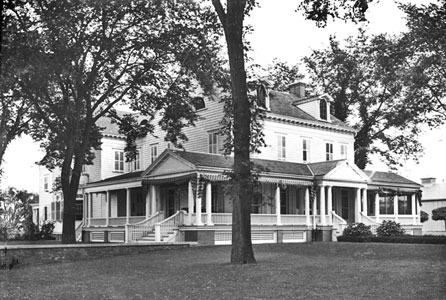
Judge Charles Lockwood House on Courtland Avenue
Built early 1900s in the Federal Style, it later became the Heroy residence, then the Low-Heywood School for Girls. It was razed in 1970. Stamford Historical Society |
||||
|
|
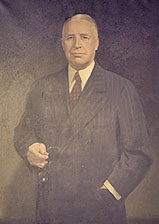
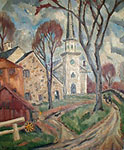
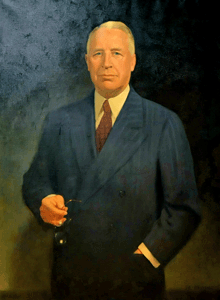 Judge Lockwood’s portraitist, Thomas Edgar Stephens, was born in Cardiff, South Wales and studied art at Cardiff University, London and Paris, before eventually settling in the United States. In 1950, Stephens was commissioned by the United States Military Academy to paint the portraits of the Army's foremost generals. His most impressive works include former U. S. presidents and First Lady Mamie Eisenhower.