| Join | Official Historian | City of Stamford | Blog | About Us | |
| Jewish Historical Society | Civil War Roundtable | Contact Us | |
 |
|
|
The Stamford Historical Society PresentsPortrait of a Family: Stamford through the Legacy of the Davenports
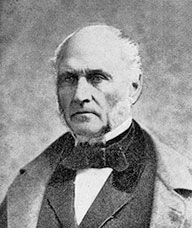
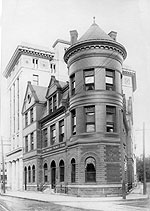
Theodore Davenport 1792–1884When Theodore Davenport started in the rolling mill business in the Roxbury-Stillwater area of Stamford in 1825, he was thirty-three years old. First of his name in the family, son of Major John Davenport and grandson of the first Abraham, Theodore purchased about seventy acres of land, together with the grist mill and saw mill thereon. He entered into a business relationship with William Lacon to operate a rolling mill, but the arrangement was short-lived. Davenport & Lacon, partners, agreed to disagree. The property was ordered sold in Superior Court and Mr. Davenport became purchaser and sole owner. He acquired a new partner, one Jonathan D. Weeks, a shrewd businessman. The firm became the prosperous Davenport & Weeks Rolling and Wire Mills. In 1827 by deed from Peter Scofield, they flooded an area on the east side of the road, raised the old dam and built a lower dam for the wire mill. They bought land on both sides of the road, up to what later became the Borglum property and also to the south. The firm merged with the Stillwater Company in 1835 and thereafter the upper mill drew larger wire, such as rake teeth, while iron rolling was done at Stillwater Mill. Sixty single men, mostly Irish, lived at the company boarding house. There was a blacksmith, stables, a slaughter house, a barn with a granary, a sawmill and tenements. Theodore married 21 year old Harriet Chesebrough of New York City in 1833 when he was 41. Their son, also named Theodore, joined his father in the rolling and wire mills business. In addition to their thriving enterprises, the elder Davenport followed his families’ tradition of community leadership and service. His name appears in the enabling act of the Connecticut State Legislature for the creation of the Borough of Stamford in 1830, after which he served as a Borough Warden for five years. A deacon in the Congregational church, he was the first president (1851-1854) of the Stamford Savings Bank and is reported to have contributed much to its success. He also served on the first board of Woodland Cemetery. Theodore Davenport died in September 1884, aged 92, at the home of his son, Theodore. He is interred in Northfield Cemetery, Stamford, the burying ground given to the Congregational church by his grandfather, Abraham Davenport. The Stamford Savings Bank On display in the exhibit:Two Oval Framed Photographs. Mid-19th century framed photographs of Theodore Sr. and his wife, Harriet Grant Chesebrough Davenport. Gift of Elizabeth Davenport Spence
This mid-19th century painting is mounted in a highly stylized Renaissance Revival frame. Harriet was the daughter of Robert and Content Chesebrough of New York City where Robert was a successful dry goods merchant and importer of fine porcelain. Escaping the raging cholera epidemic, Harriet came to Stamford with her family in 1832. She met Theodore Davenport, a bachelor of 40, at a party at the Davenport mansion on Main Street. After she and her family returned to the city, the "all important question" was settled by letter and she and Theodore were married in 1833. Harriet became active in women’s volunteer organizations including the Stamford Exchange for Women's Work and the Civil War Ladies' Soldiers' Aid Society. (see also Civil War Timeline). She was the great-grandmother of Virginia Fessenden Miller, late wife of the donor. Gift of Mr. James Don Miller
This impressive sideboard exemplifies the heavier style of the later Empire period with more emphasis on outline than in finely carved embellishments. Made of mahogany, it features three drawers across the front with cabinets below. The center cupboard has bowed front panel doors while the two end compartments have raised panels. The curved door panels and frieze are veneered with decorative crotch mahogany. The plain base rail is supported on carved lion’s paw feet on the front and straight feet at the rear. The back gallery terminates on each end with a curved post surmounted with a carved decorative cap. The sideboard was probably acquired by Harriet Grant Chesebrough Davenport and her husband Theodore for their residence on Main Street. Gift of Mrs. Elizabeth Davenport Spence
|
||||||
|
|
|||||||
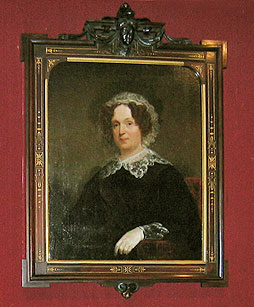 Oil Portrait
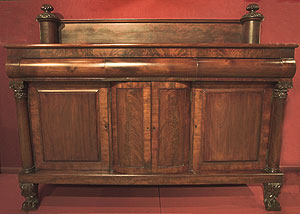 American Empire Sideboard